
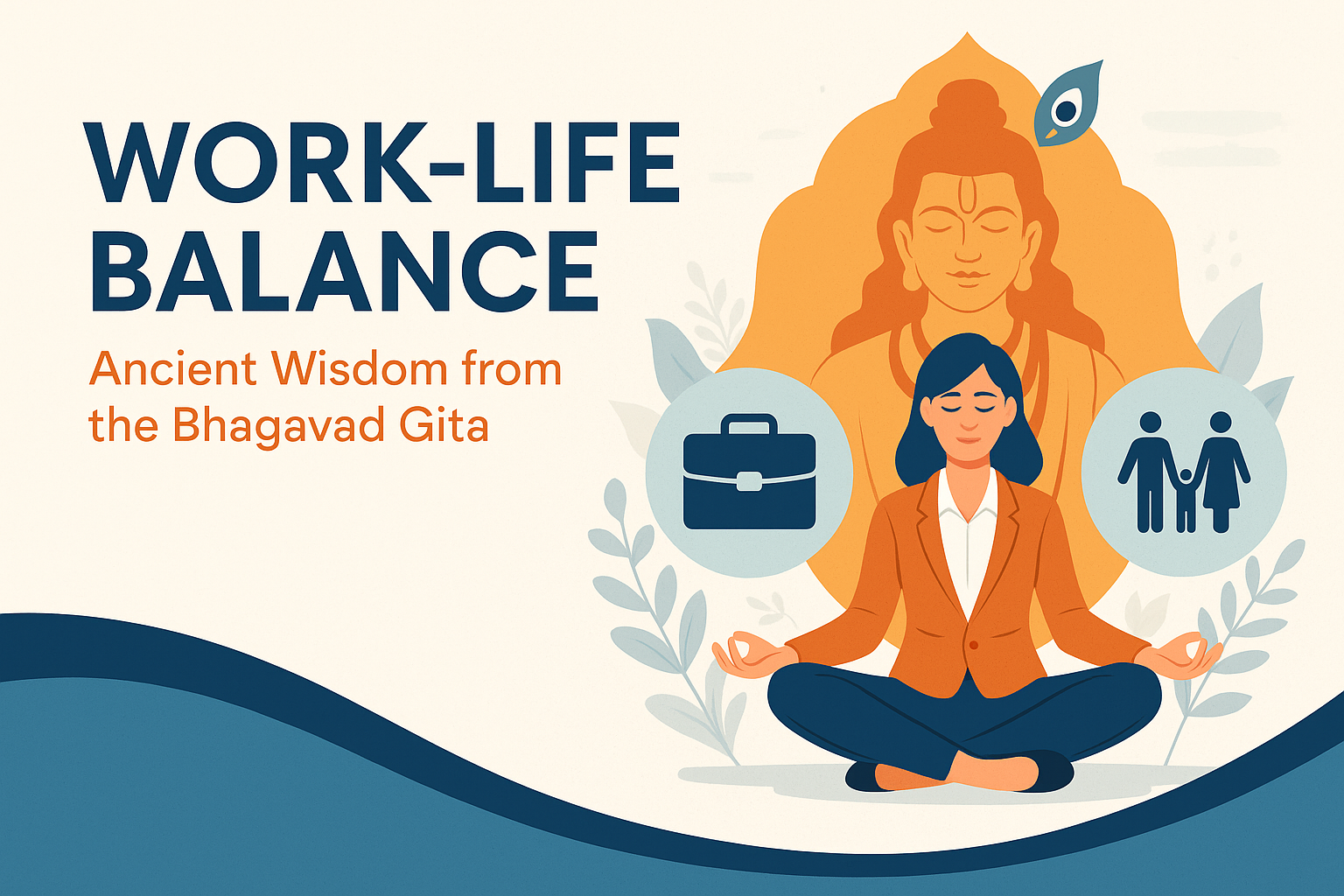
In countries like the United States, United Kingdom, and Canada, work-life balance has become one of the biggest challenges of modern life.
Long working hours, constant notifications, remote work pressure, financial stress, and emotional burnout have blurred the line between professional and personal life.
Despite advanced technology and comfort, millions of professionals report:
Chronic stress
Anxiety
Poor mental health
Lack of fulfillment
Surprisingly, the Bhagavad Gita, written thousands of years ago, offers timeless guidance on how to live a balanced, peaceful, and productive life—without quitting responsibilities or escaping reality.
This article explores how ancient Gita wisdom can help modern professionals achieve true work-life balance in today’s fast-paced world.
⭐ 1. Balance Begins with Inner Stability
“One who is not disturbed by happiness or distress is fit for liberation.”
— Bhagavad Gita 2.15
Modern stress comes from emotional imbalance, not workload alone.
When success excites us too much and failure depresses us deeply, mental exhaustion follows.
✔ Gita’s solution
Develop emotional balance—staying calm in both success and failure.
✔ Modern psychology agrees
This is called emotional regulation, a core skill taught in therapy and leadership training.
✔ How to apply
Do not tie self-worth to job titles or salary
Treat success and setbacks as temporary
Pause before reacting emotionally
Inner balance automatically improves work-life balance.
⭐ 2. Work with Commitment, Not Obsession
“Perform your duty without attachment to results.”
— Gita 2.47
Many professionals overwork because:
They fear failure
They seek validation
They feel insecure
This creates work obsession, not productivity.
✔ Gita’s teaching
Work sincerely, but detach emotionally from outcomes.
✔ Benefits
Reduced burnout
Clear thinking
Better decision-making
Healthier personal relationships
✔ Practical step
Set clear work hours and disconnect mentally after work.
Detachment is not laziness—it is wisdom.
⭐ 3. Control the Mind to Prevent Burnout
“The restless mind can be controlled through practice and detachment.”
— Gita 6.35
Burnout in Western countries is often caused by:
Overthinking
Mental overload
Continuous digital stimulation
✔ Gita’s approach
Train the mind daily instead of letting it run wild.
✔ Simple daily practices
10 minutes of mindful breathing
Limit screen time after work
Practice silence for a few minutes daily
Avoid unnecessary comparison
A trained mind creates peace—even in busy schedules.
⭐ 4. Define Success Beyond Career Growth
Many professionals believe success means:
Higher salary
Better designation
Social approval
But the Gita defines success as inner satisfaction and self-growth.
✔ Why this matters
When success is defined only externally:
Stress increases
Satisfaction decreases
Life feels empty
✔ Gita-inspired mindset
True success includes:
Physical health
Mental peace
Meaningful relationships
Personal values
This broader definition restores balance naturally.
⭐ 5. Live in the Present, Not in Pressure
The Gita emphasizes present-moment awareness.
Most stress comes from:
Regretting the past
Worrying about the future
✔ Modern term: Mindfulness
Mindfulness programs are now used by:
Corporations
Universities
Therapy clinics
✔ Practice this
Focus fully on one task at a time
Eat without screens
Walk consciously
Listen attentively
Presence reduces anxiety and improves both work and personal life.
⭐ 6. Align Work with Personal Values
A major reason for imbalance is value conflict—when work doesn’t align with personal beliefs.
Krishna guides Arjuna to follow his Dharma (inner calling).
✔ Reflection exercise
Ask yourself:
What values matter most to me?
Does my work support or harm them?
How can I bring meaning into my role?
Even small alignment reduces stress significantly.
⭐ 7. Rest Is Not a Luxury, It Is Discipline
The Gita promotes moderation in everything—work, sleep, food, and recreation.
“One who eats, sleeps, works, and relaxes in balance destroys sorrow.”
— Gita 6.17
✔ Modern science confirms
Balanced routines improve:
Productivity
Mental health
Emotional stability
✔ Action step
Fix sleep schedules
Schedule breaks intentionally
Treat rest as responsibility, not reward
⭐ Conclusion
Work-life balance is not achieved by reducing work alone—it is achieved by changing how we relate to work and life.
The Bhagavad Gita teaches that:
✔ Balance begins within
✔ Discipline creates freedom
✔ Purpose reduces stress
✔ Mindfulness restores peace
Whether you live in the USA, UK, or Canada, these ancient principles offer a practical roadmap to a healthier, calmer, and more fulfilling modern life.
When the mind is balanced, life becomes balanced.